
As part of the UN-declared International Year of Glaciers’ Preservation (IYGP 2025), the Mountain Research Initiative (MRI), together with the Forum Landscape, Alps, Parks of the Swiss Academy of Sciences (FoLAP/SCNAT) and the Interdisciplinary Centre for Mountain Research (CIRM, University of Lausanne), convened a multidisciplinary session on Glaciers and Deglaciation: Perspectives on their Relevance for Society at the 23rd Swiss Geoscience Meeting in Bern.
The session brought together researchers from across the natural and social sciences to explore what glacier retreat means, not only for physical systems, but also for ecosystems, cultures, economies, and governance in mountain regions. Against the backdrop of accelerating glacier loss worldwide, the session highlighted the importance of broadening glacier research beyond biophysical change to include human experience, knowledge systems, and future-oriented responses.
From Physical Change to Social Meaning
Several contributions examined glacier retreat as a deeply transformative process reshaping alpine landscapes and post-glacial ecosystems. Research from the Trient Valley in the Swiss Alps demonstrated how newly deglaciated terrains are rapidly colonised by vegetation, giving rise to emerging ecosystems that demand new conservation and management approaches. These physical transformations are not neutral: they alter risk profiles, recreational use, and how people relate to formerly ice-covered places.
Other presentations took a longer historical view. By analysing paintings, engravings, and early photographs from the Little Ice Age onwards, one such contribution illustrated how pictorial sources provide invaluable records of past glacier extents while also shaping cultural imaginaries of ice as sublime, threatening, or vanishing landscapes. Such work underscored the role of arts and humanities in sensemaking around climate change, an increasingly important dimension of glacier research.
Tourism, Imaginaries, and Last-Chance Encounters With Ice
One of the most animated discussions followed a presentation on last-chance glacier tourism in the Canadian Rockies. Drawing on interviews, visual analysis, and field observations at sites such as the Athabasca Glacier, the research showed how glaciers are simultaneously framed as pristine wilderness, endangered heritage, and consumable attractions. Visitors are often highly aware that glaciers are melting, yet tourism practices can paradoxically reinforce environmental pressures and romanticised narratives of loss.
These dynamics resonated strongly with Swiss experiences, where retreating glaciers have also become focal points for public attention, memorialisation, and last-chance tourism. The discussion highlighted a key opportunity: the widespread fascination with glaciers, whether in Canada or Switzerland, can be leveraged to communicate more effectively about climate change, if paired with honest narratives about responsibility, limits, and transformation.
Learning From Indigenous Knowledge in the Karakoram
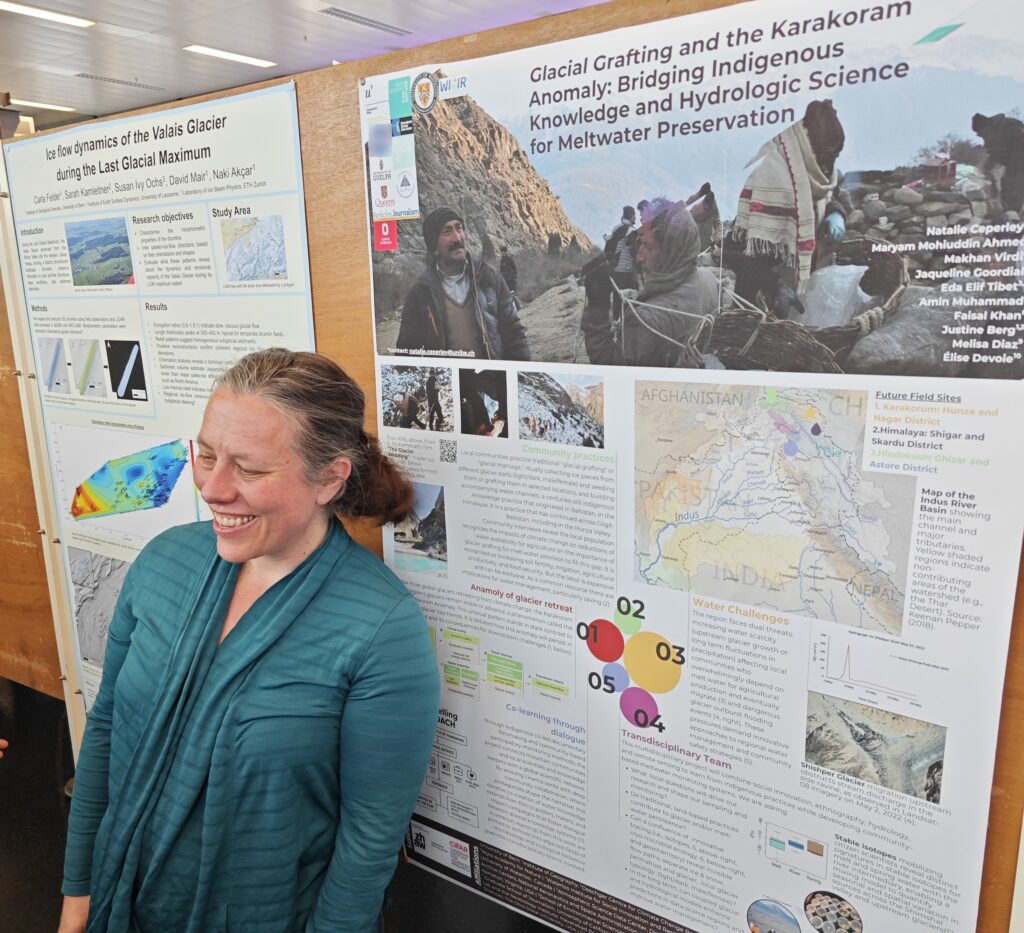
The session also featured a particularly striking poster presentation of the Karakoram region of northern Pakistan, one of the few places in the world where some glaciers remain stable or are even advancing. The research explored the practice of glacial grafting, also known as “glacier marriage,” in which communities ritually combine ice from “male” and “female” glaciers to seed new ice formations in carefully chosen locations.
While still in its early stages, this interdisciplinary research project combines ethnography, hydrology, remote sensing, and participatory documentary filmmaking to investigate whether such community-driven practices may contribute to local glacier persistence and water security. Beyond the physical question of ice dynamics, the work opened up broader reflections on resilience, knowledge pluralism, and how Indigenous practices can inform global conversations on adaptation and stewardship in mountain regions. Look out for the upcoming short documentary on this traditional practice. A trailer for the documentary can be viewed below.
Connecting Disciplines, Regions, and Futures
Across presentations and posters, a common theme emerged: glacier retreat is not only a signal of climate change, but a catalyst for rethinking how science engages with society. The session highlighted methodological diversity, from remote sensing and geomorphology to ethnography, historical analysis, and participatory approaches, and emphasised the value of integrating these perspectives within a systems framework.
By convening diverse case studies from the Swiss Alps to the Canadian Rockies and the Karakoram, the session illustrated how mountain regions worldwide are grappling with both shared and context-specific challenges. It also reinforced the role of platforms like MRI, SCNAT, and CIRM in fostering dialogue across disciplines and scales, and in supporting research that is not only scientifically robust but also socially relevant.
As a contribution to the International Year of Glaciers’ Preservation 2025, the session highlighted that responding to glacier loss is not only a technical challenge, but also a social, cultural, and governance one, calling for integrative research to better understand cascading impacts and future risks in mountain regions.
We extend our sincere thanks to all speakers, partners, and participants for a session that not only deepened understanding but sparked lively cross-disciplinary conversations on glaciers past, present, and future.
Trailer: The Glacier Wedding
You are currently viewing a placeholder content from Vimeo. To access the actual content, click the button below. Please note that doing so will share data with third-party providers.
More Information