
At the end of a year marked by environmental catastrophes, reeling from a sharp downturn in development finance, and still in the throes of geopolitical shifts, the world gathered at the UNEP headquarters in Nairobi to take decisive action to better safeguard the planet and its people.
During the seventh session of the UN Environment Assembly (UNEA-7), the world’s highest level decision-making body on the environment, delegates worked tirelessly to build consensus to address issues with wide reaching consequences for people and planet. Delegates confronted new and emerging issues, linking the environment to technology, health, and the global economy, while also considering how best to deal with ever-growing concerns pertaining to climate change, biodiversity loss, and pollution.
In the end, the Assembly adopted a Ministerial Declaration, reflecting the theme of the conference, “Advancing sustainable solutions for a resilient planet.” After much discussion, often going well into the night, delegates agreed on 11 resolutions, addressing, among others:
- global actions to promote the climate resilience of coral reefs;
- international cooperation on the environmentally sound management of minerals and metals;
- the global response to the massive influx of Sargassum seaweed blooms;
- synergies, cooperation or collaboration for national implementation of multilateral environmental agreements (MEAs) and other relevant environmental instruments;
- the meaningful participation of youth in environmental processes and on environmental education;
- the preservation of glaciers and the broader cryosphere, in particular in mountain regions;
- the global management of wildfires; and
- the sound management of chemicals and waste.
The adopted resolutions also address topical issues, including the environmental sustainability of artificial intelligence (AI) systems and the environmental dimensions of antimicrobial resistance (AMR), as well as to promote sustainable solutions through sport for a resilient planet—all new areas of work for the UN Environment Programme (UNEP). Delegates were, however, unable to reach consensus on resolutions addressing deep-sea ecosystems, karst ecosystems, and crimes affecting the environment.
To ensure the smooth functioning of UNEP, they held sometimes fraught negotiations, finally reaching consensus on three decisions, related to: the Medium-Term Strategy (MTS) for the period 2026–2029 and the Programme of Work (PoW) and budget for the biennium 2026–2027; the management of trust funds and earmarked contributions; and the provisional agenda, dates, and venue of UNEA-8.
UNEP also launched the seventh edition of the Global Environment Outlook (GEO-7), but delegates were unable to agree on how best to reflect it in relevant decisions, finally agreeing not to include reference to the seminal report in the decision on the MTS. The launch of GEO-7 was nevertheless welcomed in the Ministerial Declaration. A resolution aiming to strengthen UNEP headquarters in Nairobi also proved too contentious, with delegates eventually opting to drop it, and perhaps revisit it at a future meeting of the Assembly.
Over 6,000 delegates registered for the meetings, which brought together representatives from governments, civil society, academia, youth, and business and industry. UNEA-7 was preceded by the seventh session of the Open-ended Committee of Permanent Representatives (OECPR-7), which made progress on negotiating the resolutions and decisions eventually considered by the Assembly. UNEA-7 featured a High-level Segment, where delegates shared experiences, engaging in leadership and multi-stakeholder dialogues.
The meetings took place from 1-5 December and 8-12 December 2025 at UNEP headquarters in Nairobi. During the course of the meeting, delegates also convened in the first Women’s Environment Assembly, the Youth Assembly, the Global Major Groups and Stakeholders Forum and numerous side events.
This article is reproduced from the IISD Earth Negotiation Bulletin.
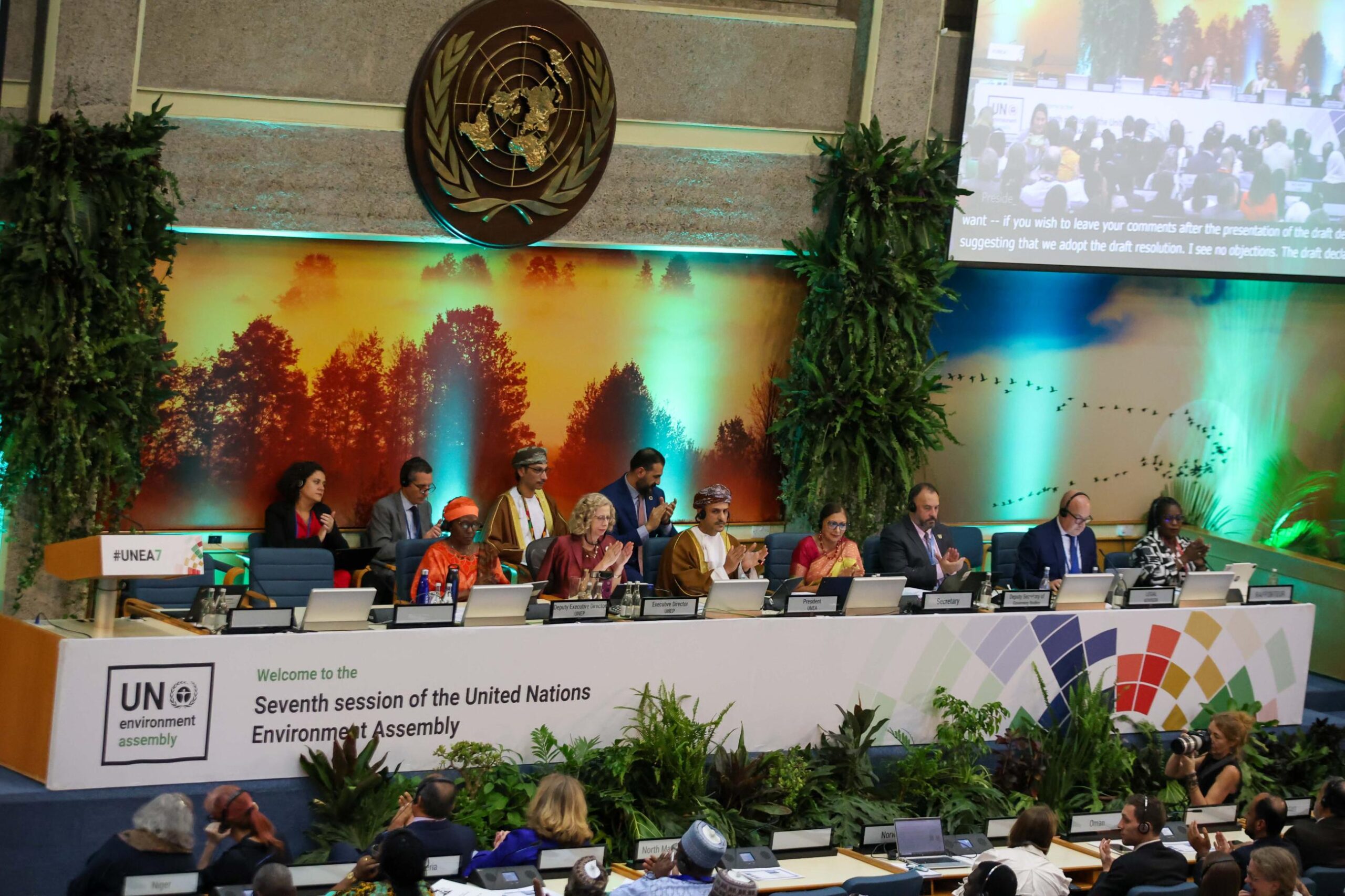
Cover image: A view of the dais during the closing plenary. Photo by IISD/ENB | Anastasia Rodopoulou.