

Switzerland’s warming since the 1950s is not uniform across its mountains. New research by MeteoSwiss shows lowlands heat up faster in autumn and winter as fog declines, while mid-elevations warm slightly more in spring due to snow loss. The study also reveals that some popular climate datasets miss or misrepresent these elevation-specific signals.
Strong Warming, Some Elevational Differences
Since the 1950s, Switzerland has warmed markedly throughout the year, with the strongest temperature increases occurring in summer and spring, as revealed by a recent high-quality MeteoSwiss dataset.[1] The analysis by MeteoSwiss is based on time-consistent gridded temperature data at a fine spatial resolution of two kilometers, allowing detailed insights across complex terrain. Two elevation-dependent patterns emerge (cf. Fig. 1): enhanced spring warming at mid-elevations, and a sharp contrast between low and high elevations from September to January, with lowlands warming more strongly during this period.
Fog and Snow Changes Shape Warming
The pronounced contrast between low and high elevations in autumn and early winter has been noted before, but the physical drivers behind it have remained largely unexplored. The new results point to a highly significant increase in sunshine duration on the low-lying fog-prone Swiss Plateau – totaling to roughly 150 hours or 25 percent since the 1950s – while basically no change is observed in the Alps in higher elevations above about 1500 m above sea level (cf. Fig. 2).
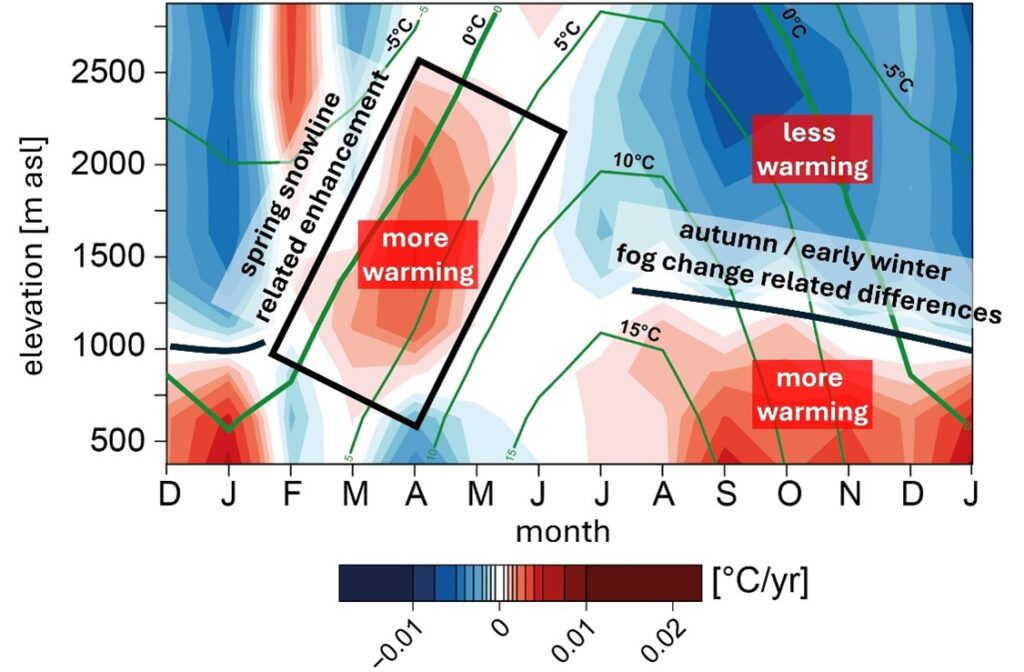
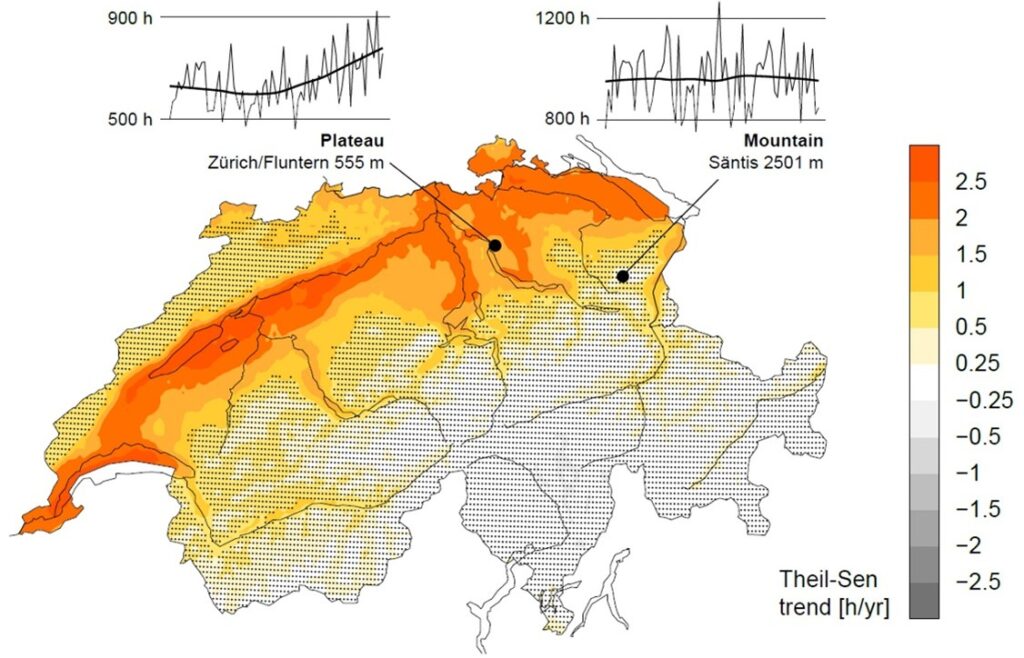
A fog proxy indicates a pronounced decline in fog and low stratus frequency, identifying it as the main driver of the elevational differences. What exactly causes the fog reduction, however, remains unresolved, as changes in large-scale weather patterns alone are unlikely to account for the full magnitude of the trend. By contrast, the enhanced spring warming at mid-elevations is attributed to snow–albedo feedback linked to rising snowlines, a mechanism that has been shown in climate studies of the Alps for a long time.
Gaps in Popular Climate Datasets
Comparisons with widely used climate products reveal important limitations. ERA5 and ERA5-Land reanalyses capture the enhanced spring warming at mid-elevations, but overestimate its strength by a factor of three to five and show a delayed response during the year. They also fail to reproduce the pronounced lowland warming in autumn and early winter, in part because fog and low stratus clouds are inadequately represented. Standard versions of the gridded E-OBS dataset display spurious elevation-dependent warming signals, whereas the homogenized E-OBS HOM dataset reproduces the observed elevation-dependent patterns with very good accuracy.
Main Takeaways
Detecting elevation-dependent warming in mountains remains challenging and requires time-consistent, high-resolution observational datasets, as relying on standard gridded products or reanalyses alone may not produce accurate trends. This also affects estimates of future changes and their impacts. Climate models should be evaluated and calibrated against high-quality observational datasets that capture all key processes that shape the warming across different elevations.
Citation: Scherrer, S.C., Isotta, F.A., Kotlarski S. 2026. Elevation-dependent warming in Switzerland: Observed signals and dataset limitations, Journal of the European Meteorological Society, 4,100026: https://doi.org/10.1016/j.jemets.2025.100026
[1] Isotta et al. (2019) https://doi.org/10.1029/2018JD029910