

Climate change is reshaping agriculture in unexpected ways, particularly in water-scarce, mountain-fed regions like Central Asia. New research in south-eastern Kazakhstan reveals that warming may reduce maize water demand – but at the cost of shorter growing seasons and declining yields.
A new study published in Agricultural Water Management explores how climate change will reshape maize production in south-eastern Kazakhstan – a semi-arid region where agriculture depends heavily on meltwater from the Tien Shan mountains. Using field data and advanced crop modelling, the research offers a nuanced picture: while warming is expected to reduce crop water needs, it will also likely depress yields.
A Region Under Pressure
South-eastern Kazakhstan relies on snow and glacier melt as a primary water source for irrigation. However, rising temperatures are accelerating cryosphere degradation, threatening long-term water availability. Despite widespread concern about increasing irrigation demand under climate change, there has been limited modelling evidence to guide adaptation in this region.
To address this gap, the researchers calibrated and validated two crop-water models, AquaCrop and SALTMED, using field data collected between 2016 and 2019. They then simulated maize growth, water requirements, and yields under future climate conditions using projections from four global climate models under moderate (RCP4.5) and high-emissions (RCP8.5) scenarios through to 2100.
Faster Growth, Lower Water Use
The results consistently show that rising temperatures will accelerate maize development. By the end of the century, the growing season is projected to shorten by roughly 38-45 days. This compressed lifecycle reduces the time crops need water, leading to a projected decline in water requirements of 11–24%.
However, the benefits of reduced water demand come with a trade-off. Higher temperatures – especially those exceeding maize’s optimal range – are expected to reduce yields by 6–11% by 2100. The decline is driven primarily by heat stress and the shortened growing period, which limits biomass accumulation and grain development.
“Our results indicate that although maize yields are projected to decline, primarily due to heat stress, crop water requirements are also expected to decrease because of the shortening growing season,” says paper co-author Maria Shahgedanova, Professor of Climate Science at the University of Reading and lead of the MRI Mountain Observatories Working Group. “This suggests that, contrary to common assumptions, future crops may require less, rather than more, irrigation water.”
Implications for Adaptation
According to Shahgedanova, these findings are particularly relevant for adaptation planning in Central Asia. While reduced water demand may ease pressure on scarce water resources, declining yields pose a challenge for food security and farm incomes.
The study highlights several potential strategies to mitigate these impacts:
- Improving irrigation efficiency to sustain yields and reduce water losses
- Adjusting sowing dates to better align with water availability
- Adopting shorter-maturing maize varieties suited to warmer conditions
Rethinking Water and Agriculture Under Climate Change
Overall, the research underscores the importance of region-specific modelling in understanding climate impacts. In meltwater-dependent systems like the Tien Shan foothills, climate change does not simply increase water demand – it reshapes the timing and efficiency of water use in complex ways. As Central Asia faces a warmer future, such insights will be critical for designing agricultural systems that can sustain both productivity and water resources.
Read more: Baktybek Duisebek, Maria Shahgedanova, Andrew J. Wade, Ragab Ragab, Zarina Saidaliyeva, Nikolay Kasatkin, ‘Climate warming accelerates maize phenology and reduces water requirements and yields in south-eastern Kazakhstan,’ Agricultural Water Management, Volume 329, 2026, 110343, ISSN 0378-3774, https://doi.org/10.1016/j.agwat.2026.110343
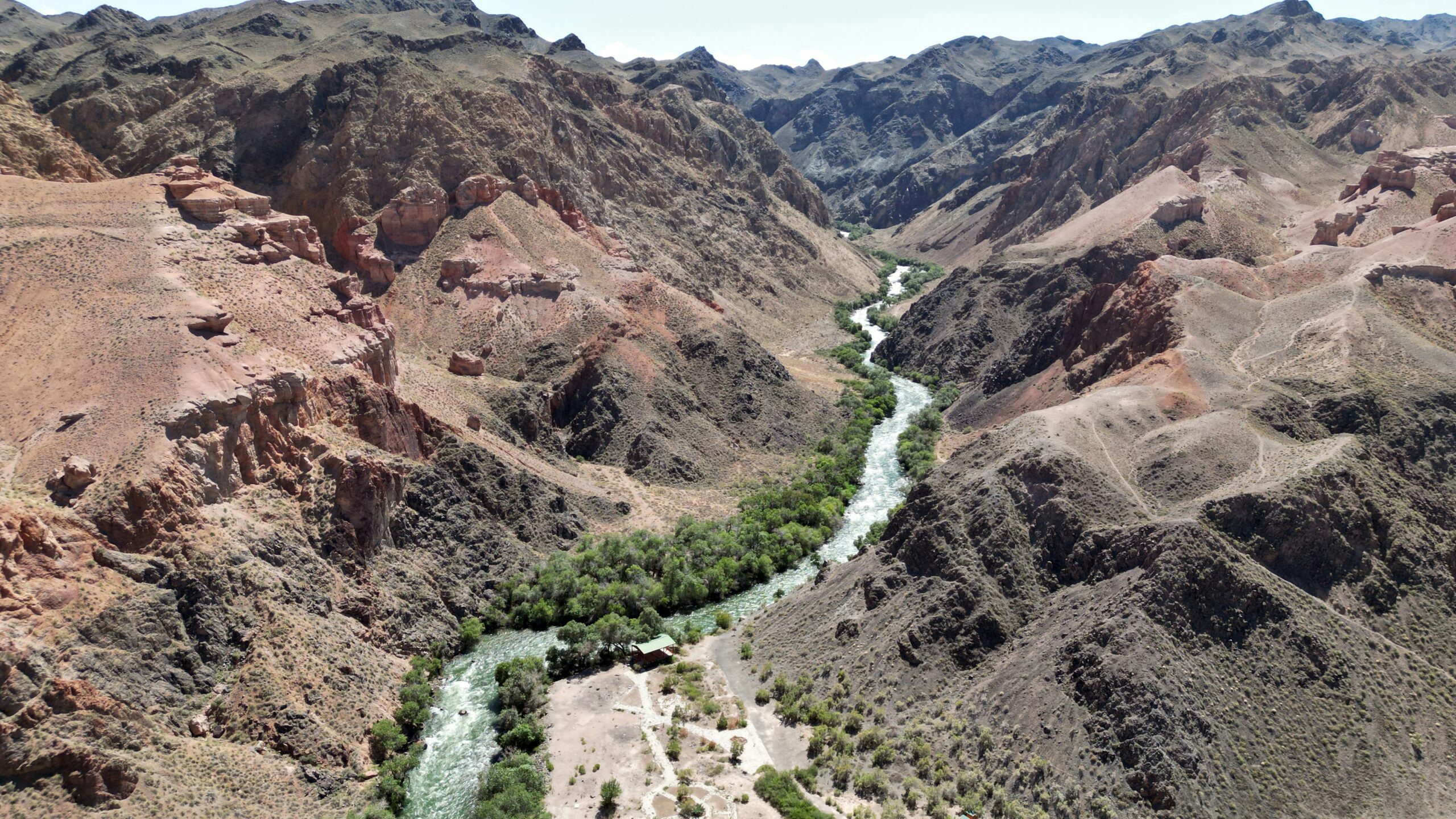
Photo by Anatolii Shcherbyna.