
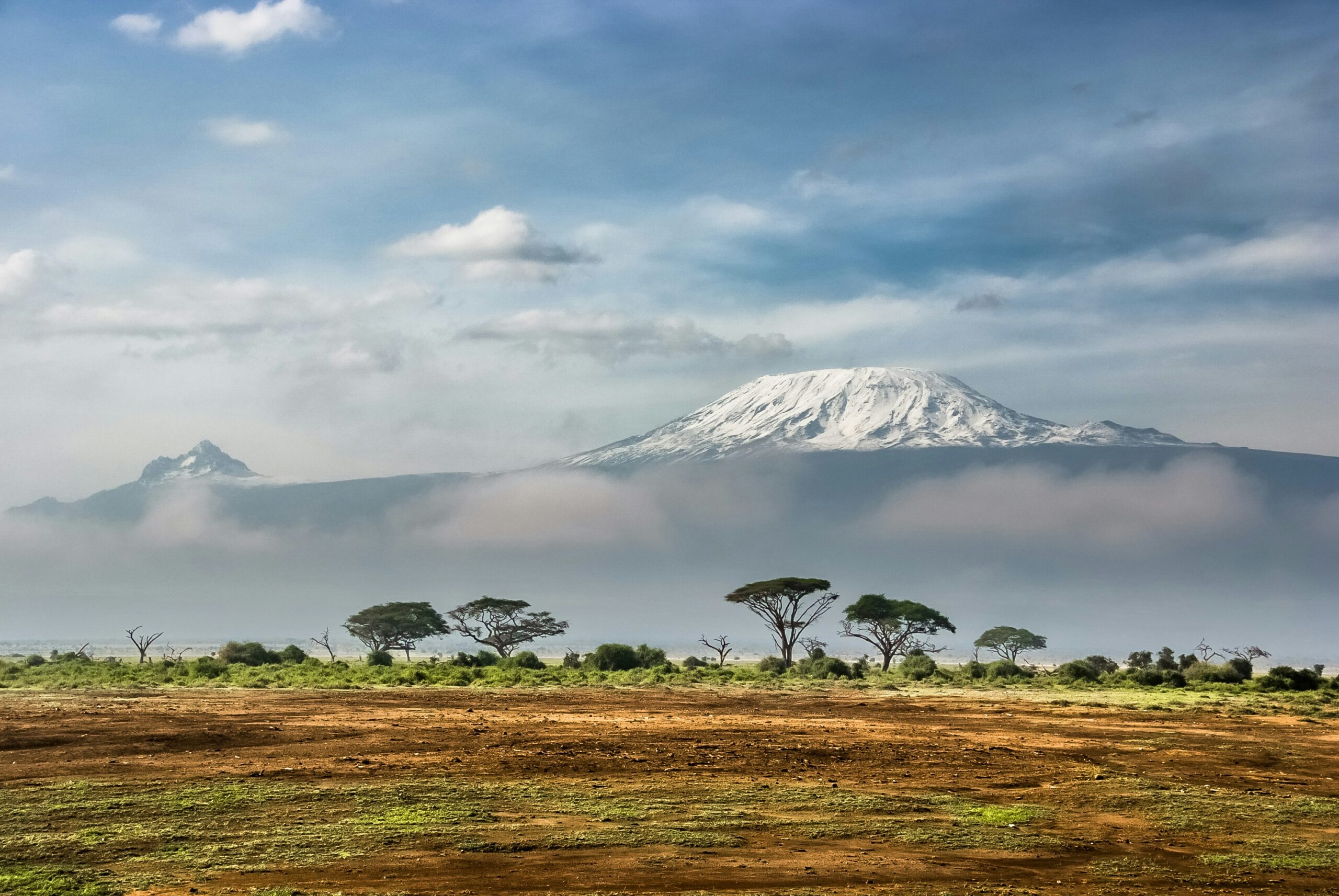
High above the farms and forests of northern Tanzania, Mount Kilimanjaro has been quietly recording the story of a warming world. Thanks to support from a GEO Mountains Small Grant, researchers have now unlocked more than two decades of unique climate data from across the mountain’s dramatic elevation range, revealing how climate change is reshaping ecosystems, water supplies, and livelihoods from summit to savannah.
A Mountain-Wide Climate Record
For over 20 years, a transect of 22 climate sensors has stretched from Kilimanjaro’s lower slopes at 900 metres to its icy summit at nearly 5,800 metres above sea level. Led by Dr Nick Pepin with colleagues Ehsan Khalefa, Yaping Mo, and Simon Mtuy, a research project now offers an unusually detailed picture of how warming varies across one of Africa’s most iconic mountains.
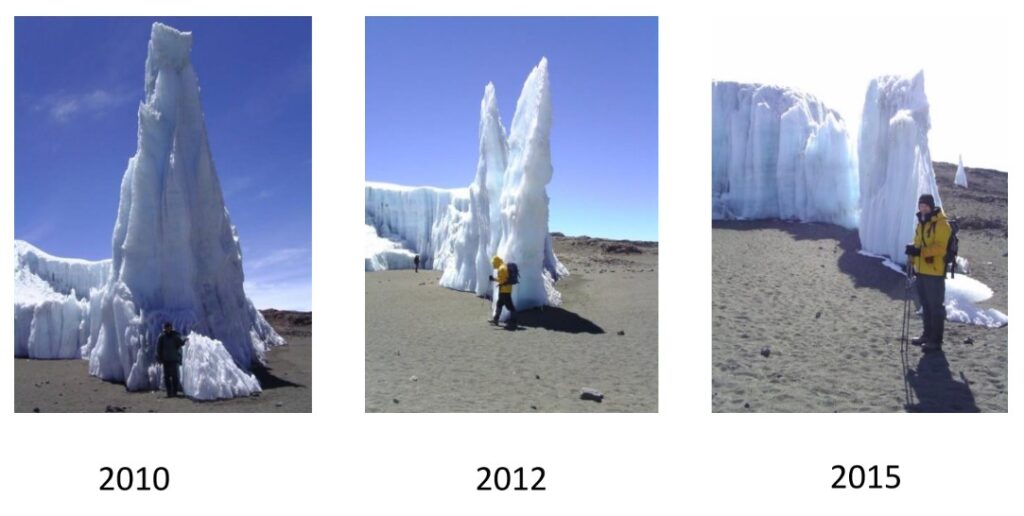
During a field campaign in January 2025, the project team successfully recovered data from the sensors, securing a dataset spanning from September 2004 to January 2025. The results are striking: higher elevations on Kilimanjaro are warming about twice as fast on average compared to lower sites and are already showing clear impacts, including the rapid loss of snow and ice. Across the mountain, humidity and moisture patterns are changing, while deforestation is contributing to drying in significant areas.
“We are immensely grateful to GEO Mountains for providing funding to allow us to capitalise on over 20 years of data on climate change across the slopes of Kilimanjaro, and to apply this data to improve our understanding of the consequences of climate change on the lower slopes,” says project lead Dr. Nick Pepin. “It has also enabled the development of strong links with local schools, farmers, and communities in the region, and has stimulated further collaborations which will develop this critical work further.”
From Satellites to Soil
The team also used their ground-based observations to validate satellite data, developing a model that translates land surface temperatures measured from space into real-world air temperatures. This tool makes it possible to track elevation-dependent climate change across the entire mountain using satellite measurements, including remote or difficult-to-access areas.
At the same time, researchers worked closely with farming communities on Kilimanjaro’s lower slopes, conducting interviews and surveys on their experience of climate change impacts across four regions. These conversations revealed how changing rainfall, rising temperatures, and land-use pressures are affecting water availability, crop choices, and livelihoods. In response, many farmers are adapting by diversifying crops or adjusting irrigation practices.
Benefits Beyond the Data
The project’s impact extends well beyond scientific papers, three of which are now in preparation. An interactive website has been developed that allows users to explore Kilimanjaro’s climate data directly, while outreach activities have helped inspire the next generation. In January 2025, around 200 schoolchildren in Moshi took part in sessions on why mountains matter, combining climate science with creativity and art.
Looking ahead, the team is working to ensure the long-term future of the climate transect by strengthening partnerships with local institutions and training Tanzanian scientists to lead ongoing monitoring, including working with the College of African Wildlife Management which is located on Kilimanjaro’s lower slopes.
From in situ sensors to classroom conversations, this GEO Mountains-supported project brings together long-term observations, open data, and local knowledge to strengthen our understanding of climate change on Kilimanjaro and its consequences for us all.
GEO Mountains Small Grants Call 2026-2027
The third GEO Mountains Small Grants Call 2026-2027 welcomes proposals that address mountain monitoring, data, and information, with priority given to projects in the following mountain regions: Andes, Central Asia, East Africa, South Caucasus, and Hindu Kush Himalaya. Projects that consolidate the ‘state-of-the-art’ or promote transformative research capabilities for sustainable mountain development are particularly encouraged.
The GEO Mountains Small Grants Call 2026-2027 is open until 20 February 2026, 23:59 CEST.