

Rising temperatures and increasingly frequent droughts are affecting regions worldwide. In polar and high-mountain areas, warming is thawing permafrost, triggering a cascade of environmental changes. This includes altered water availability, increasing natural hazards, and the release of long-stored carbon into the atmosphere, as recent research in Switzerland has shown.
How do these processes amplify climate change and its impacts?
High Air Temperatures: Impacting Permafrost and Water Availability
Heat is the main suspect. High air temperatures in spring and summer directly warm permafrost, in particular if the snowpack – normally acting as an insulating blanket – has melted earlier in spring and is increasingly absent in summer. Without this cover, heat can penetrate deeper into the ground. In turn, in winter, snow-free permafrost areas benefit from low temperatures that can cool the ground more effectively (Nötzli et al. 2025).
In high-alpine environments such as the Swiss Alps, warming of the permafrost can modify groundwater flow and affect slope stability, increasing the risk of landslides, debris flows, and rockfall.
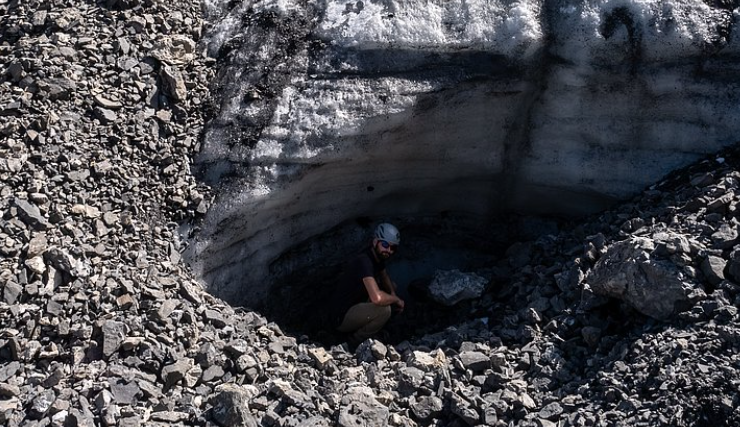
Glaciers and permafrost often interact with each other. Glacier erosion can, for example, cause the oversteepening of rock walls at their base, thereby destabilizing them. In parallel, rising temperatures can cause permafrost ice plugs to melt and allow water to flow deep into rock fractures. The resulting water pressure can weaken the rock masses and lead to rock avalanches. In some cases, these are deposited on glaciers, as occurred in the case of the Klein Nesthorn rock avalanche that landed on the Birch glacier above Blatten in Switzerland.
For a long time, particularly in the European Alps, glaciers have been crucial for water storage. They reliably supplied meltwater in early summer, when it was most important. However, glacier runoff is expected to decline sharply as warming continues. Under a medium emissions scenario, annual runoff in the European Alps from currently glacierized areas is projected to decrease by 16% by 2070–2099, despite relatively stable annual precipitation. Late-summer runoff is expected to decline even more – by around 37% (Farinotti et al., 2016).
Drought: Dry Soils and Stronger Extremes
A warmer atmosphere can intensify drought by increasing evaporation and altering rainfall patterns. Globally, droughts are becoming more frequent, longer lasting, and spatially larger (Chen et al., 2025 ). Even in the European Alps – the so-called water tower of Europe – the intensity of drought events has increased (Zappa et al. 2025). Rainfall is becoming less frequent, but heavier. After a prolonged drought, the capacity of dry soils to absorb intense rainfall is reduced, increasing the risk of surface runoff and flooding. At the same time, low soil moisture reduces evaporation – a key cooling mechanism – and thus can further amplify heat waves (Domeisen 2025).
In some cases, permafrost thaw / ground ice melt can lead to the release of organic and inorganic pollutants, potentially impacting water quality in below streams (Wanner et al.,2024).
But drought has even more implications. Apart from intensifying heat waves, drought increases the risk of forest fires (Pezzatti et al. 2025), weakens soils, and increases the likelihood of mudslides and landslides during heavy rainfall (AghaKouchak et al., 2023). Trees under water stress are more vulnerable to pests and disease, ultimately leading to forest dieback. Beyond natural hazards, drought has a direct impact on agriculture, hydropower production, river navigation, industrial cooling, tourism, and ecosystem functions and services.
Feedback Loops: Carbon Release and Reinforced Warming
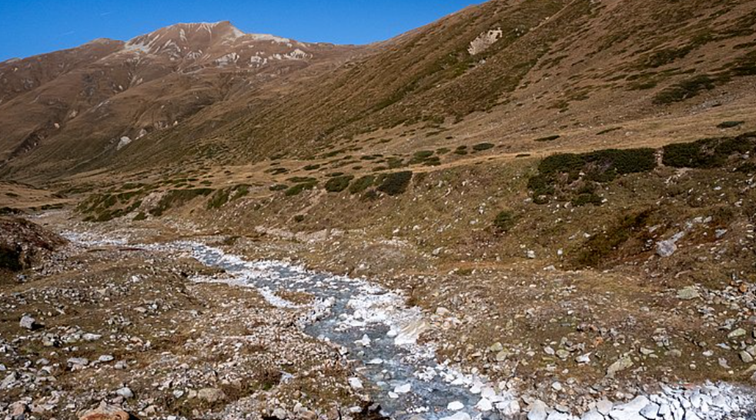
High-alpine soils store organic carbon that becomes increasingly stable with elevation and low temperatures. As permafrost thaws, previously frozen organic matter becomes available for microbial decomposition, releasing additional CO₂ and methane. This could create a treacherous feedback loop in which warming causes thaw, thaw releases greenhouse gases, and those emissions drive further warming. Recent research has shown, however, that only small amounts of CO2 are released from alpine soils to the atmosphere, which is likely compensated for by new plant growth on so far non-vegetated land.
Below the tree-line, forests – as long as they are in a healthy state – play a vital role in absorbing CO₂, thereby buffering climate change. Yet this balance is shifting. At lower elevations, heat and drought are currently reducing the ability of forests to absorb carbon, turning them – in extreme cases – into net CO₂ sources. Above approximately 1,500 meters, higher soil moisture still allows forests to function as strong carbon sinks, but this advantage may diminish as warming continues (Zimmermann et al., 2024).
Reducing Risk: Mitigation and Adaptation
Although the root cause of increasing heat and drought lies in global climate change and must be addressed through sustained emissions reduction, adaptation measures are still essential. Healthy water bodies, for instance, are more resilient to climate stress. Pollution control, regulated water withdrawals, river restoration, and managing flow fluctuations from hydropower plants all help to protect water resources and aquatic ecosystems on which we depend. Authorities can further reduce risk by diversifying water supplies, increasing storage capacity, protecting groundwater resources, and – where appropriate – artificially recharging aquifers. Multi-purpose reservoirs, including new installations in areas of glacier retreat, may help buffer drought impacts. Apart from these measures targeting solely the provisional side of water management, adaptations are unavoidable at the water demand side. Finally, society must anticipate and prepare for the impacts of a warmer, drier, and less predictable climate (Björnsen et al. 2025: 73 and 87).
Tools for Monitoring and Preparedness
- WSL-Bericht EXtremes (Björnsen et al. 2025) summarizes selected findings presented at the WSL Forum für Wissen 2025.
- WSL EXtremes WebApp provides a playful insight into the effects of various climate scenarios for the next 20 years: how global warming is already noticeable today in exceptional cases, how it is predicted on average, and how it could manifest itself under extreme circumstances.
- Federal Drought Warning Platform informs on current conditions and four-week forecasts for precipitation, runoff, soil moisture, and groundwater.
- Final report WSL Research Program Climate Change Impacts on Alpine Mass Movements – CCAMM
- WSL Drought Research Platform offers experimental forecasts to support agriculture and forestry.
- maps.wsl.ch presents products developed at the WSL and the SLF – namely spatial data – in a cartographic, interactive, agile and dynamic way. The maps are available in German.
- Heat Action Toolbox (Federal Office of Public Health) provides practical guidance in German for dealing with extreme heat, particularly for vulnerable groups.
- Detailed Glacier Data shows glaciers and their changes can be closely monitored via the ‘Crampon’ App.
Cover image: The EXtremes web app illustrates how climate change impacts are interconnected and can cascade across systems.