
A new synthesis funded by the Mountain Research Initiative and the French National Research Agency, and conducted in partnership with the French National Research Institute for Sustainable Development, identifies five priorities for advancing research on mountain futures in the face of growing uncertainty. Based on 25 case studies from around the world, the study provides a framework for strengthening the resilience and sustainability of mountain ecosystems and the societies that depend on them.
As mountain regions find themselves on the front line of climate and societal change, research and policy frameworks addressing these challenges still pay too little attention to the role of uncertainty. Drawing on 25 case studies conducted across 18 countries on five continents, an international team proposes a new research agenda aimed at strengthening the resilience, inclusivity, and sustainability of mountains and the societies that depend on them. Published in Cell Reports Sustainability, this synthesis identifies five key principles for turning uncertainty into a catalyst for action rather than a barrier to decision-making.
Mountains on the Front Line of Climate Change
Glaciers are retreating, permafrost is thawing (thereby also releasing greenhouse gases), water resources are becoming scarcer, biodiversity is declining, and livelihoods such as fishing, farming, livestock rearing, and tourism are becoming increasingly vulnerable. Together, these accelerating environmental and societal changes are making the future of mountain regions and the people who depend on them ever more uncertain.
Although nearly half of the world’s population depends directly or indirectly on resources provided by mountains, current research approaches, which are often based on sector-specific projections and focused primarily on assessing the impacts of climate change, are insufficient to address the complexity of the transformations underway in these regions.
Making Uncertainty a Driver of Adaptation
To address this challenge, the researchers analysed 25 case studies representing major mountain ranges across Africa, Europe, Asia, North America, and South America. This international comparison enabled them to identify five research priorities for better anticipating the transformations taking place in mountain regions and securing a sustainable future for mountain ecosystems and the communities that depend on them.
- Co-produce knowledge by bringing together researchers, local communities, Indigenous Peoples, and decision-makers to develop solutions that are tailored to the realities of each region and meet the needs of all stakeholders.
- Bridge disciplines, particularly the social and biophysical sciences, to better understand the interactions between environmental dynamics and human societies. The authors also call for greater integration of citizen science and participatory approaches.
“Beyond advancing scientific research, this study provides an operational framework to guide future public policies. It calls for a shift from reactive responses to an anticipatory approach based on collective learning, stakeholder participation, and recognition of the many forms of uncertainty.” – Anaïs Zimmer, Geographer at the French National Research Institute for Sustainable Development (IRD).
- Adopt a multi-scale perspective, spanning from local to transboundary levels and from the short to the long term. Long-term changes in climate or water resources are closely interconnected with short- and medium-term socio-political actions, including economic development, governance, and spatial planning. As climate change impacts accelerate in mountain regions, understanding how they propagate across different spatial and temporal scales is essential for developing sustainable adaptation solutions.
- Develop forward-looking approaches based on anticipating possible future scenarios rather than simply reacting to crises. Such approaches should incorporate emerging concepts including urban and rural economic systems, community self-determination, public sector accountability, and power relations.
- Establish anticipatory governance that systematically and holistically integrates scientific knowledge, traditional knowledge, and climate considerations into decision-making processes.
“This framework can serve as a reference for researchers, protected area managers, local authorities, and decision-makers addressing the challenges of climate change adaptation in mountain regions around the world.” – Carolina Adler, Executive Director of the Mountain Research Initiative (MRI).
More Information
Reference: Zimmer A., Grêt-Regamey A., Palomo I. et al. A Research Agenda for Mountain Futures. Cell Reports Sustainability. 2026. DOI: 10.1016/j.crsus.2026.100775
Press contact:
Joséfa Balavoine
Email: josefa.balavoine@ird.fr
Tel: +33 6 08 34 41 29
IRD Press Release: View the original version of this press release (in French) on the IRD website.
About the Mountain Research Initiative
The Mountain Research Initiative (MRI) is an international research coordination network dedicated to advancing global change research for sustainable mountain development.
Bringing together researchers and practitioners from diverse disciplines and regions, the MRI fosters collaboration to improve understanding of how environmental and societal change affects mountain social-ecological systems. By integrating scientific and other forms of knowledge, the MRI supports evidence-informed policy and practice, promotes systems approaches to mountain research, and helps build the next generation of mountain researchers and professionals.
Through these efforts, the MRI contributes to a more sustainable and resilient future for mountain communities and the ecosystems on which they depend.
About the French National Research Institute for Sustainable Development (IRD)
As a French institute for international scientific research, IRD contributes to strengthening the resilience of societies in response to the challenges of global change. It operates in over 50 countries across Africa, Latin America, Asia, the Pacific, as well as in mainland France and the overseas territories.
Its research activities address priority needs in practical ways: mitigating and adapting to climate change, combating poverty and inequality, preserving biodiversity, improving access to healthcare, and understanding social dynamics. Research projects are developed in collaboration with stakeholders on the field and local communities. Teams integrate different perspectives, disciplines, and knowledge through long-term partnerships to build robust, high-impact solutions.
IRD advocates for research that benefits the broadest population possible. It openly shares research results and leverages science for action. In this way, it supports the transformation of societies towards more just and sustainable, social, economic, and ecological models.
This work was funded by the Mountain Research Initiative (MRI) and its Mountain Social-Ecological Futures Working Group through support from the Swiss Academy of Sciences (Project No. FNW0009_004-2023-01), and by the French National Research Agency (ANR) under grant ANR-24-CE03-7304 – TierrasNuevas.
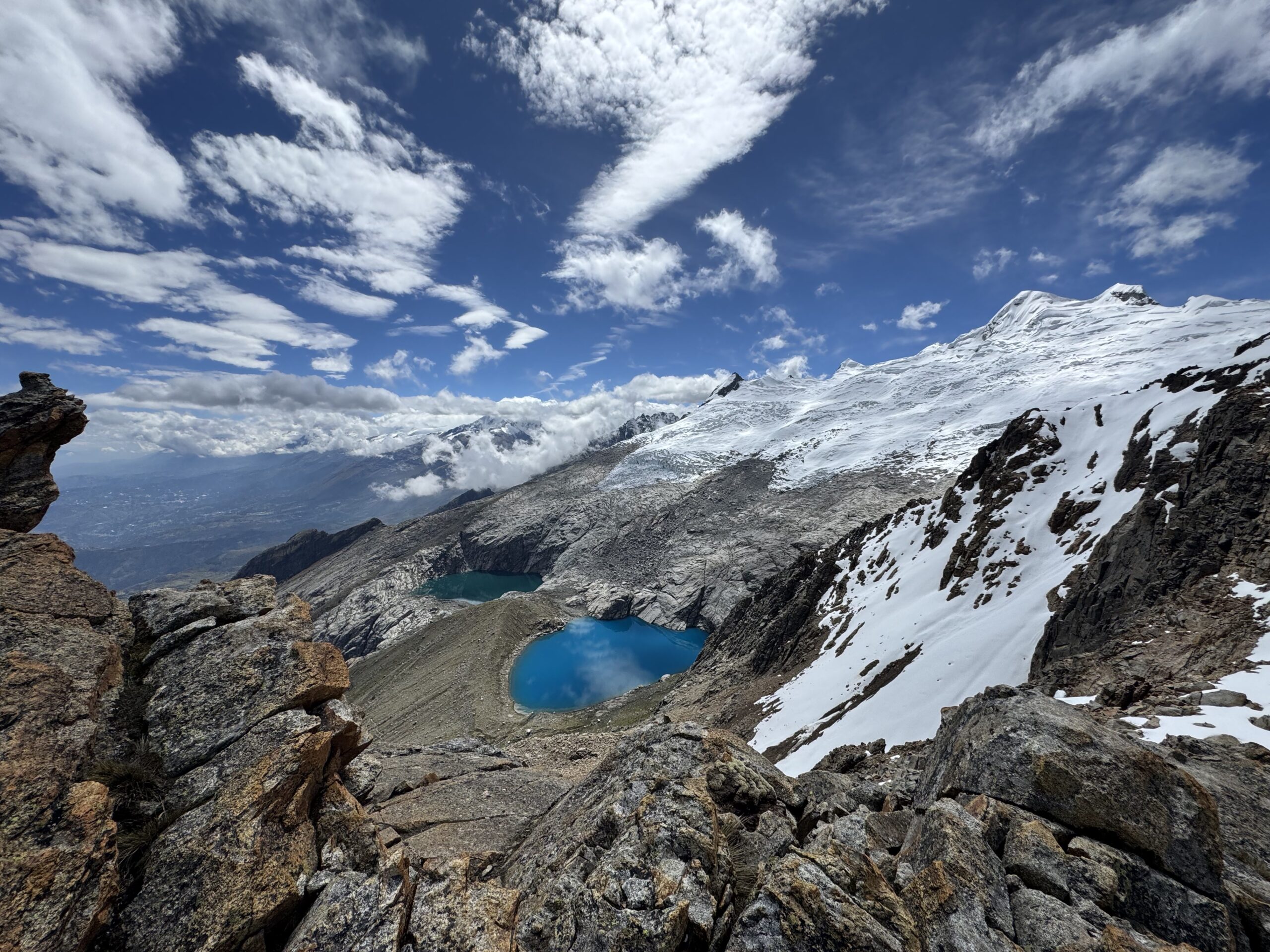
Cover image: At the foot of Vallunaraju (5,686 m a.s.l.), at El Paso del Zorro (4,950 m a.s.l.). As glaciers retreat, water resources are declining, affecting the downstream city of Huaraz (population: 144,000), local and regional agriculture, high-Andean ecosystems, and livelihoods throughout the Callejón de Huaylas. Cordillera Blanca, Peru (2025). Image credit: Anaïs Zimmer, IRD.