

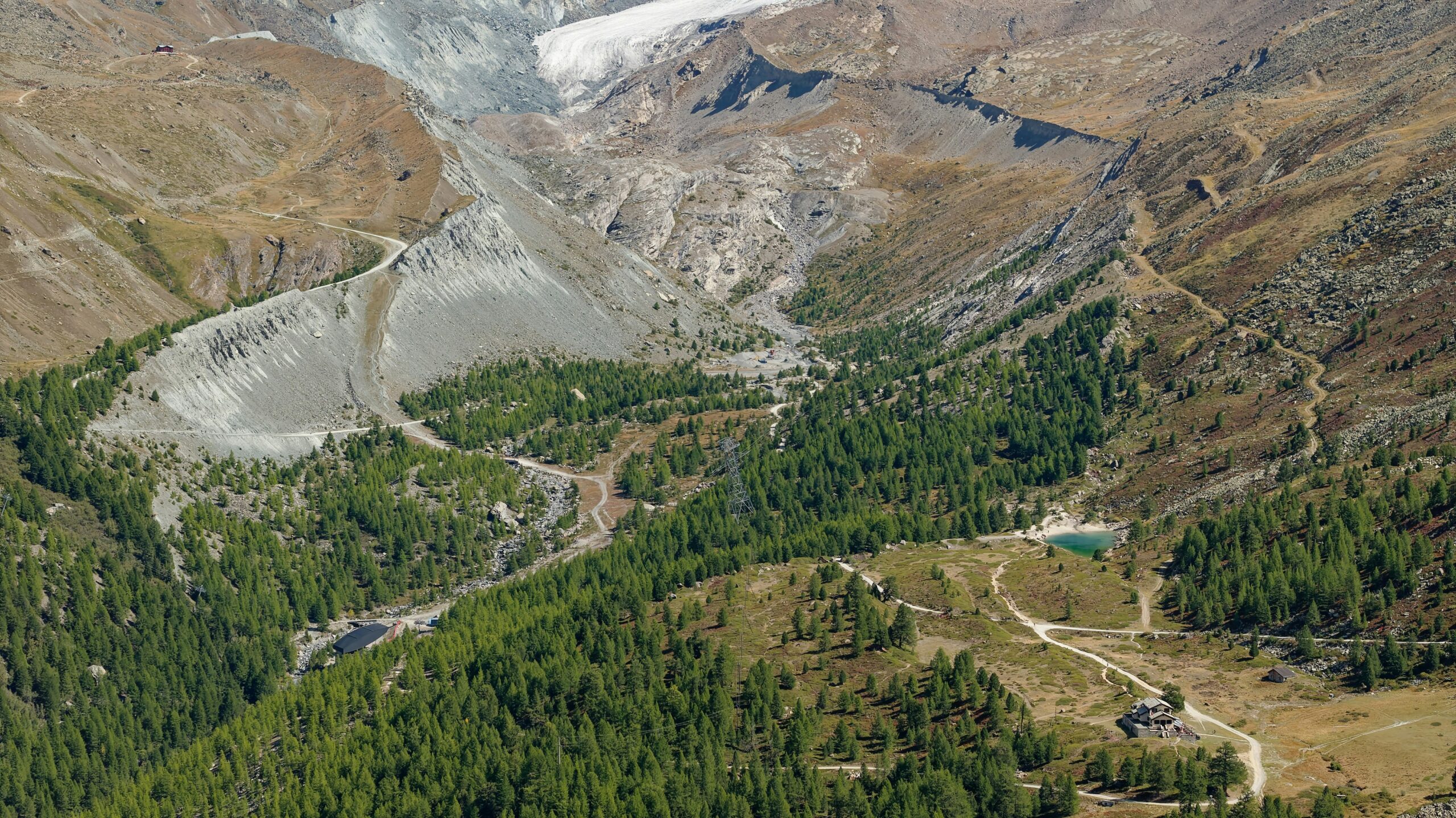
As glaciers retreat, new landscapes are emerging across the Swiss Alps, where new ecosystems, changing water systems, and growing demands for land and their resources are creating complex challenges for environmental governance. A new study explores how decisions about these areas are made, revealing tensions between competing interests and the need for more coordinated, inclusive approaches.
Switzerland’s retreating glaciers are leaving behind more than bare rock. New lakes, rivers, and emerging ecosystems are transforming the high Alpine landscape, creating valuable habitats while opening up possibilities for hydropower generation, tourism, and other activities. As these landscapes take shape, however, they are also raising difficult questions about how they should be managed, protected, and developed, and who gets to decide their future.
A new study, published in the Journal of Environmental Policy & Planning, examines how Switzerland governs these newly exposed areas, known as glacier forelands. The findings reveal that while numerous laws and policies regulate their use and protection, the absence of a coherent, overarching framework is creating challenges for sustainable and fair decision-making.
New Landscapes, Competing Priorities
Between 1850 and 2023, approximately 935 square kilometres of land became ice-free in Switzerland, with hundreds more potentially emerging by the end of the century as warming accelerates. These rapidly changing landscapes offer important opportunities for biodiversity as species establish themselves in newly exposed terrain, while also attracting growing interest from sectors such as hydropower and tourism.
Drawing on expert interviews, legal and policy analysis, and spatial data, the researchers found that glacier forelands are governed by a complex patchwork of regulations covering energy, water, spatial planning, and nature conservation. Responsibilities are spread across different levels of government, often with overlapping or conflicting objectives.
These tensions have become particularly pronounced as Switzerland seeks to expand renewable energy production. Glacier retreat is creating potential sites for new hydropower infrastructure, yet many of the most promising locations also overlap with ecologically valuable or protected areas. Recent legislative reforms prioritising renewable energy development have further complicated the balance between energy security and nature conservation.
Without a coordinated long-term approach, decisions are frequently made on a project-by-project basis, creating uncertainty and making it difficult to consider the wider consequences of development across these emerging landscapes.
Balancing Urgency with Fairness
Importantly, the study also examines process justice, or the fairness of the procedures through which decisions are reached.
The researchers identify several concerns, including outdated ecological data, uneven opportunities for stakeholder participation, and recent changes to the mechanisms available for challenging decisions. While efforts to accelerate infrastructure development may support Switzerland’s energy transition, they can also weaken the procedural safeguards intended to ensure that different interests are fairly represented.
“Glacier retreat is not only transforming our mountain landscapes, but also challenging the institutions responsible for managing them,” says study co-author Adrienne Grêt-Regamey, Professor at the Chair of Planning Landscape and Urban Systems at the Institute for Spatial and Landscape Development, ETH Zürich and MRI Principal Investigator. “The decisions we make today will shape these emerging environments for generations, making it essential that they are informed by reliable science, consider competing interests, and involve those affected.”
Governing a Changing Mountain Future
Looking forward, the researchers call for stronger coordination between policy sectors, updated conservation inventories, and more inclusive planning processes, alongside a longer-term vision for glacier forelands that considers their ecological importance, potential uses, and changing natural hazards.
Although the study focuses on Switzerland, its findings have wider relevance for mountain regions worldwide, where glacier retreat is creating new landscapes and challenging established approaches to environmental governance.
As climate change continues to reshape mountain environments, the research highlights that responding effectively will require more than scientific understanding and technical solutions. It will also depend on whether the institutions and decision-making processes governing these landscapes can adapt to the pace of environmental change.
Read more: Odermatt, G., Hartman, J., Lieberherr, E., Baruffa, C., & Grêt-Regamey, A. (2026). ‘Governing the Retreat: Institutional Fragmentation and Process Justice in Swiss glacier Forelands.’ Journal of Environmental Policy & Planning, 1–26. https://doi.org/10.1080/1523908X.2026.2728166
This research is highly relevant for, and directly relates to, the goals pursued under the UN Decade of Action for Cryospheric Sciences, and is an excellent example of the type of topics and research contributions that the MRI promotes as part of this observance.
Adrienne Grêt-Regamey is Co-Lead of the MRI Mountain Socio-Ecological Futures Working Group. To find out more about this Working Group, including how to get involved, please click here.
Cover image: The Findel Glacier valley in Zermatt, Switzerland. Photo by Daniel R. on Unsplash.