
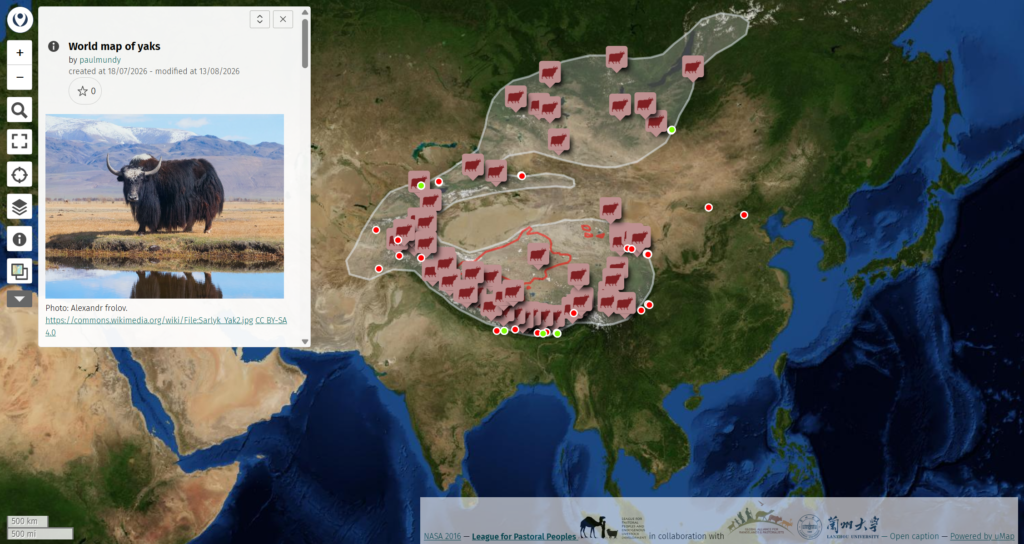
A new world map brings together the global distribution of yaks with the pastoralist communities that depend on them and the organisations working to support yak research and development.
Produced by the League for Pastoral Peoples and Endogenous Livestock Development in collaboration with Lanzhou University, China, the World Map of Yaks offers a unique overview of the people, places, and organisations connected to one of the world’s most distinctive mountain livestock species.
The map identifies around 70 pastoralist groups who keep yaks and nearly 50 organisations involved in yak research, development, and support. It also shows the approximate range of the domesticated yak (Bos grunniens) and the distribution of its wild relative, the wild yak (Bos mutus).
At Home in the High Mountains
Yaks are central to pastoral livelihoods across the cold, high mountains and plateaus of Central Asia, thriving in environments where few other livestock species can survive.
An estimated 14–15 million domestic yaks are found worldwide, more than 90% of them in China. Mongolia is home to around 600,000, while smaller populations are found in Bhutan, India, Kyrgyzstan, Nepal, Pakistan, Russia, and Tajikistan.
For the communities who raise them, yaks fulfil many roles. They provide milk for butter and cheese, meat, wool and fibre, and hides and skins. They serve as pack and riding animals and provide draught power, while their dung is used both as fertiliser and as an essential source of fuel in high-altitude landscapes where wood is scarce.
Beyond their traditional range, yaks have also been introduced to North America, Europe, and New Zealand, where they are raised for a variety of purposes, including landscape maintenance.
Mapping a Global Yak Community
The idea for the map originated with Professor Lóng Ruìjūn of Lanzhou University, a former member of the MRI Science Leadership Council, who also provided much of the information on which the map is based. The map’s producers additionally acknowledge Yang Xin of Lanzhou University for their close collaboration in its development.
By bringing together information on yak distributions, pastoralist peoples, and the organisations working with them, the map provides a valuable entry point for exploring the relationships between livestock, livelihoods, knowledge, and high-mountain environments across different regions.
The World Map of Yaks forms part of a wider series of maps on pastoralism developed by the League for Pastoral Peoples and Endogenous Livestock Development. Other resources map pastoralist groups, threats to pastoralism, migration routes, videos on pastoralism, and camelids.
The map is intended as an evolving resource, and comments, additions, and corrections are welcome. Feedback can be sent to mapping@pastoralpeoples.org.
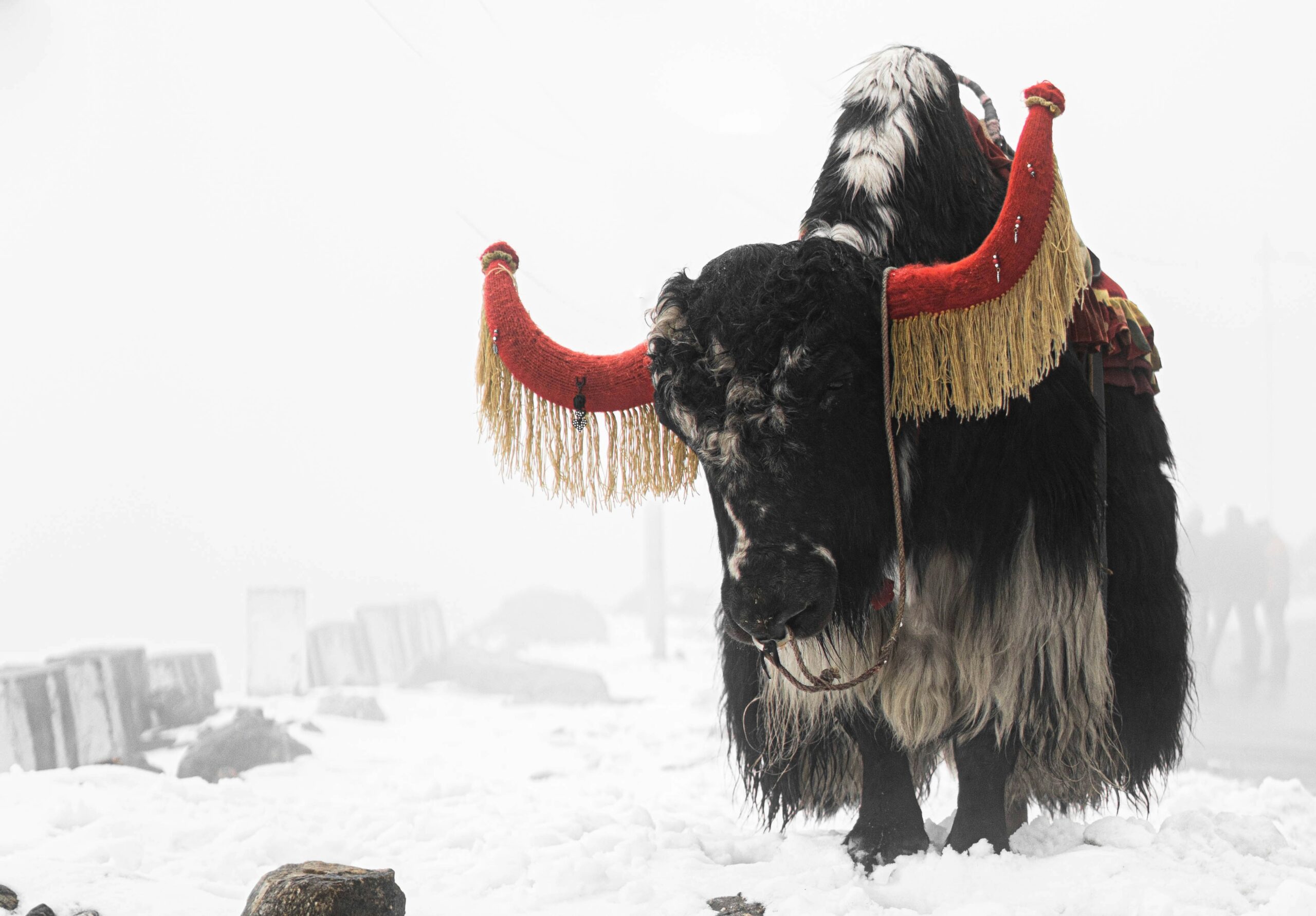
Cover image by Satya Deep.