
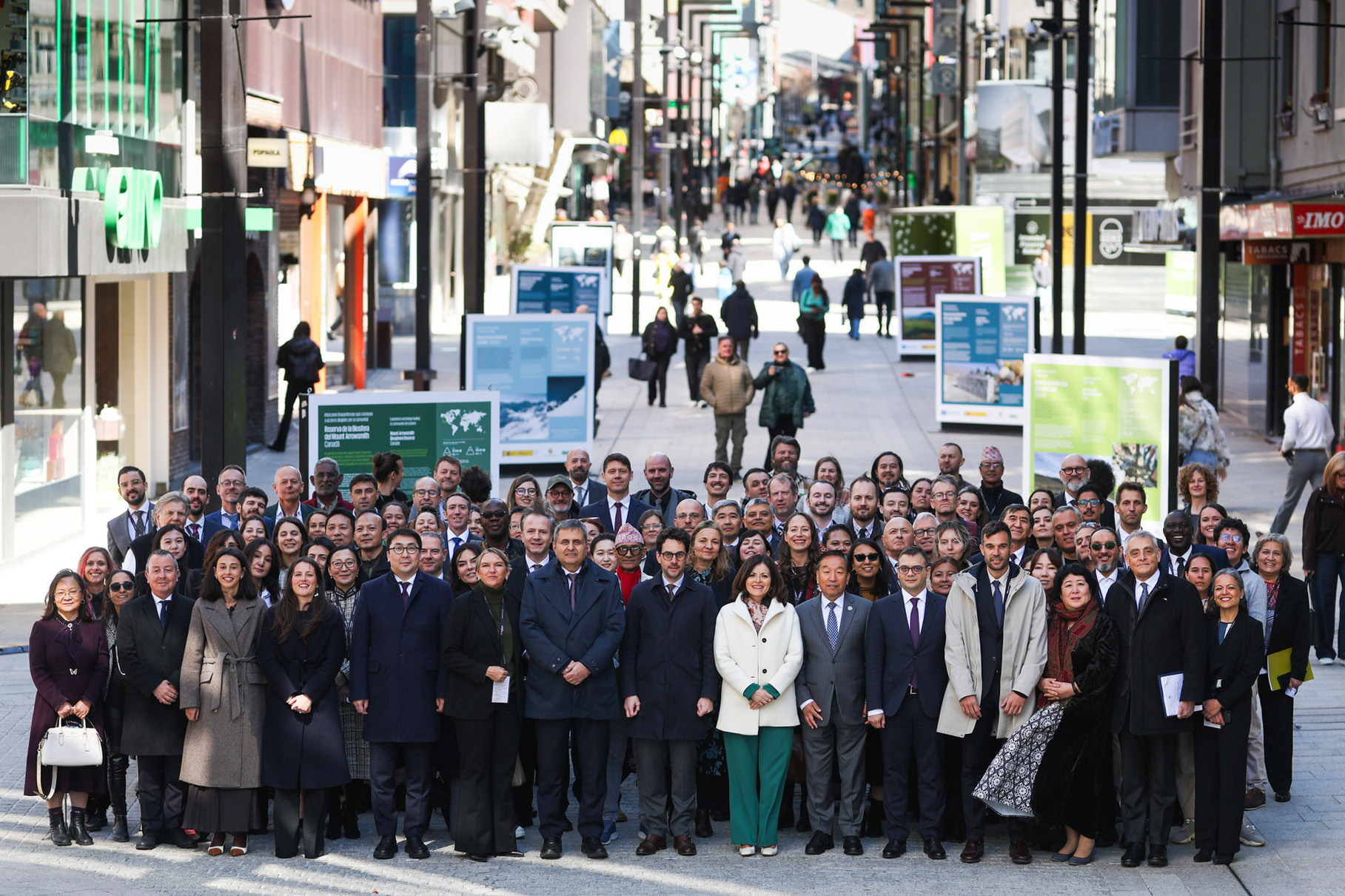
As a member of the Mountain Partnership, the Mountain Research Initiative (MRI) played an active role at its Seventh Global Meeting, held from 26-28 March 2026 in Andorra. MRI Executive Director Carolina Adler and Chair Jörg Balsiger represented the MRI network in key plenary discussions, side events, and mountain agenda deliberations.
Bringing together more than 150 representatives from governments, international organizations, and civil society across over 40 countries, the Seventh Global Meeting of the Mountain Partnership focused on advancing sustainable mountain development in the face of escalating pressures from climate change, biodiversity loss, land degradation, and today’s complex global political context. With mountain regions covering nearly a quarter of the Earth’s land surface and supporting 1.2 billion people, participants emphasized the urgency of coordinated, science-informed action and stronger integration of mountain issues into global policy agendas.
From Dialogue to Direction: Key Outcomes
A key outcome of the Global Meeting was the adoption of the Andorra Declaration ‘Elevating Mountain Action Beyond 2030’, reaffirming both the vulnerability and global importance of mountain regions, and committing members to enhanced collaboration, climate-resilient development, and inclusive governance over the next four years. Among the commitments listed in the Declaration, members reaffirmed a pledge to strengthen science-policy and multi-stakeholder dialogue within the Mountain Partnership, including enhancing capacities for knowledge sharing and transfer, science and research, and observation and monitoring infrastructure and networks.
Members also endorsed the new Governance, Advocacy, and Communication Strategies of the Mountain Partnership for 2026-2030, and elected a new Steering Committee to guide the Mountain Partnership over the next four years.
Strengthening the Science-Policy Interface
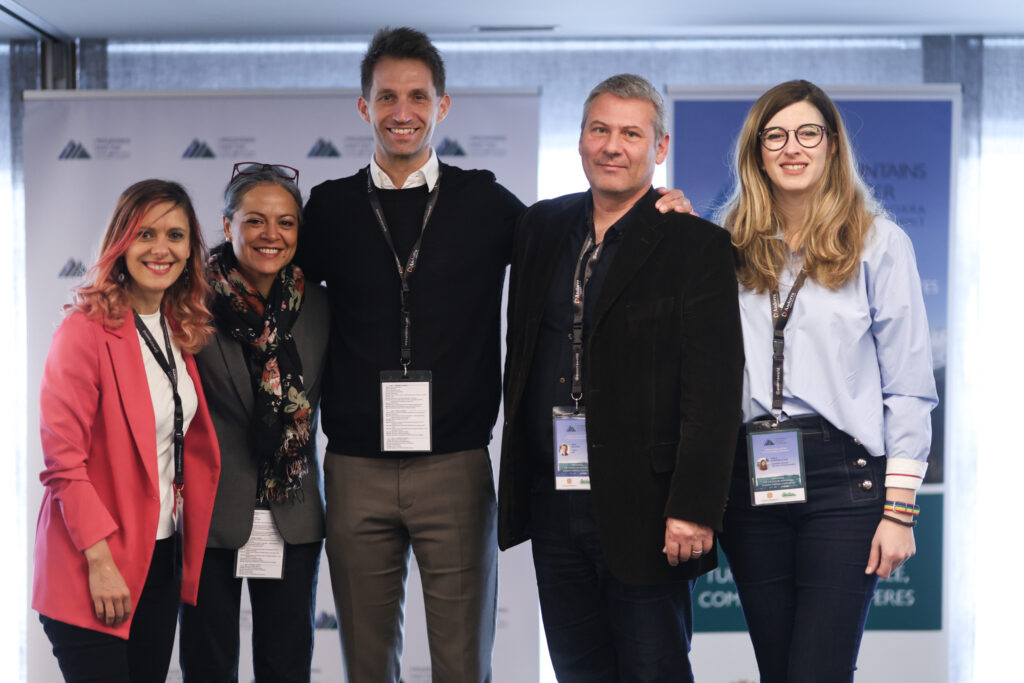
MRI Executive Director Carolina Adler contributed to Plenary Panel 1 on ‘Climate Action – Fostering the Science and Policy Network’, which explored how to better connect scientific knowledge with policymaking. The session underscored the growing risks facing mountain systems – from glacier retreat to increasing hazards – and the need for coordinated engagement in upcoming global policy processes, including the UNFCCC COPs, the Convention on Biological Diversity (CBD), the 2030 Agenda, and the Five Years of Action for the Development of Mountain Regions. It also stressed the importance of building on the momentum of the International Year of Glaciers’ Preservation 2025 throughout the Decade of Action for Cryospheric Sciences (2025–2034).
In her intervention, Adler highlighted the importance of demonstrating the impact of research and knowledge networks in supporting sustainable mountain development. Reflecting on the MRI’s 25th anniversary in 2026, she emphasized that building and sustaining knowledge communities is essential for generating actionable outcomes:
“Demonstrating added-value and impact requires clarity on how we, as a knowledge community-building entity, generate relevant and concrete outcomes for sustainable mountain development. Dialogue and exchange with policy, practice, and societal actors provide this clarity and are necessary if science and research are to make salient contributions. For us at the MRI, knowledge and community building is a permanent and evolving task, as is fostering integrated knowledge. My hope is that this task is recognised as integral in fulfilling the vision and mission that connects this entire Mountain Partnership community.”
Her contribution reinforced a central message of the meeting: that stronger links between science, policy, and society are critical for effective climate action in mountain regions.

Advancing Cryosphere Science and Global Collaboration
MRI Chair Jörg Balsiger contributed as a panellist in a UNESCO side event on the Decade of Action for Cryospheric Sciences (2025–2034). The discussion examined how UNESCO-designated sites can serve as ‘natural laboratories’ for monitoring glacier, snow, and permafrost change, while supporting community-based adaptation.
Among the issues explored, Balsiger highlighted the role of global mountain research networks such as the MRI in connecting scientific knowledge with policy processes and local realities, as well as the diverse mechanisms that support meaningful and effective exchange. Such mechanisms range from formal arrangements (e.g., MoUs) to participatory or project-based collaborations. Their effectiveness depends on being well-defined and adequately resourced, as well as inclusive across disciplines, scientific communities, and regions. He also underscored the importance of cross-regional and interdisciplinary coordination, and of building on shared knowledge to strengthen exchange mechanisms, particularly in areas such as long-term monitoring, data comparability, and collective impact – key priorities for the Decade of Action for Cryospheric Sciences (2025–2034).

Fostering Regional Exchange Through Adaptation at Altitude
The MRI was also an organizing partner of the side event ‘Adaptation at Altitude: Connecting the World’s Mountains for Knowledge Exchange and Climate Action’, at which both Adler and Balsiger actively engaged. The session brought together representatives from mountain regions worldwide to share experiences and identify common challenges in climate adaptation.
Combining community storytelling with expert dialogue, the event highlighted the value of regional cooperation, interregional exchange, and science-policy engagement in strengthening resilience. Discussions pointed to the need to scale up collaborative approaches that connect local knowledge with global policy processes, including upcoming UNFCCC and CBD negotiations.
Looking Ahead
Across plenary sessions and side events, several cross-cutting priorities emerged: scaling up financing for mountain adaptation, strengthening ecosystem protection, promoting sustainable tourism, and ensuring inclusive participation of local communities, including Indigenous Peoples and youth.
The Global Meeting also provided an opportunity to revisit the commitments under the UN-declared Five Years of Action for the Development of Mountain Regions (2023-2027) and to begin planning for the Second Global Mountain Summit ‘Bishkek+25’, to be held from 21-23 October 2027 in Bishkek, Kyrgyzstan.
The MRI’s engagement throughout the meeting highlights its continued role in advancing integrated knowledge, fostering global research collaboration, and strengthening the science-policy interface in support of sustainable mountain development worldwide.


Further reading:
- Andorra Declaration
- Mountain Partnership Event Webpage
- Government of Andorra 7th Global Meeting of the Mountain Partnership Official Website
- IISD’s Earth Negotiations Bulletin Summary Report and Highlights
Cover image: Group photo of participants at the Seventh Global Meeting of the Mountain Partnership. Image credit: IISD/ENB | Government of Andorra.