
The Mountain Research Initiative (MRI) convenes a global community of researchers and practitioners across disciplines, regions, and scales to advance global change research in mountains.
The MRI’s Working Groups are one of several community-led activities that enable the MRI network to come to life: bringing people and thought leaders together around shared themes, fostering collaboration, generating knowledge and outputs that contribute to advancing mountain research, and helping connect mountain research to global scientific and policy discussions and agendas.
Since 2017, the MRI Working Groups have addressed a wide range of topics relevant to mountain research and global change, including climate science, governance, resilience, education, observatories, and social-ecological systems. Over the years, several Working Groups have successfully completed their original objectives, leaving a legacy of high-profile publications, international workshops, policy engagement, and collaborative opportunities and outputs that continue to support the mountain research community today. One example of this is the MRI Working Group on Education for Sustainable Mountain Development, led by MRI Chair Jörg Balsiger and former MRI SLC Member Kenichi Ueno, which helped advance international dialogue and collaboration on this topic. Information on previous Working Groups and their outputs can be found on the MRI website.
Active MRI Working Groups
Elevation-Dependent Climate Change (EDCC)
The Elevation-Dependent Climate Change (EDCC) Working Group continues to play a leading role in advancing our understanding of how climate change unfolds differently along elevational gradients. Led by Nick Pepin, Associate Professor in Climate Science at the University of Portsmouth in the UK, and colleagues, the group has helped establish EDCC as an important framework for understanding mountain climate dynamics.
A major milestone in the last year was the publication of a review article in Nature Reviews Earth & Environment synthesising global knowledge on elevation-dependent climate change and highlighting the urgent need for improved high-elevation observations and monitoring.
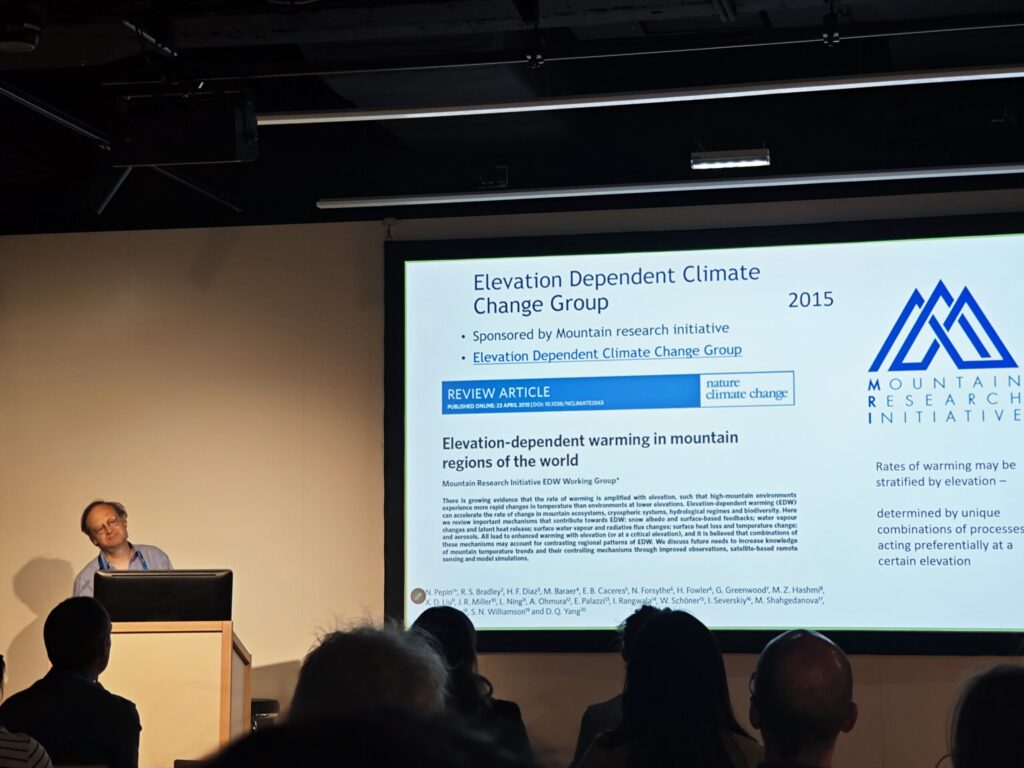
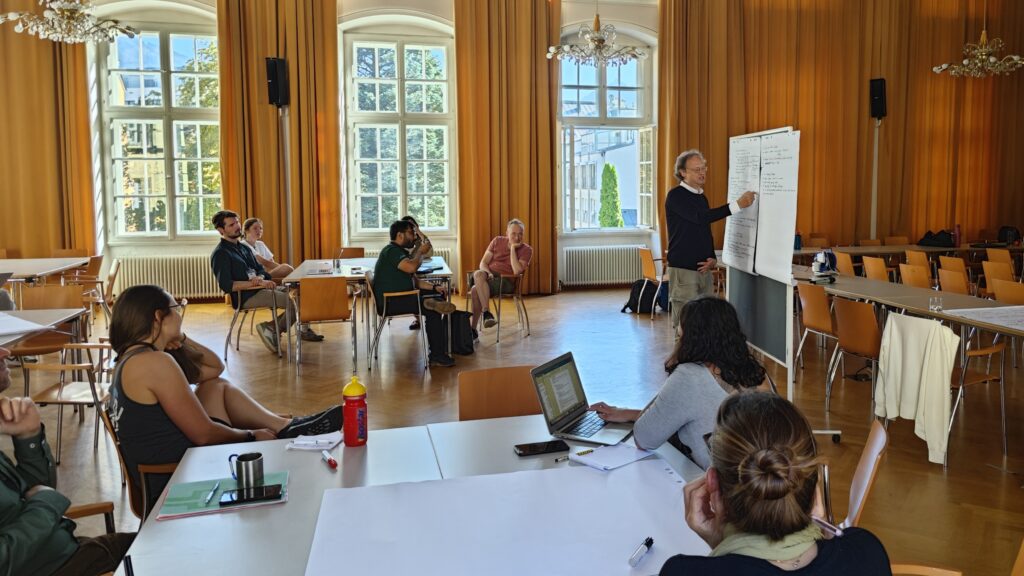
More recently, the Working Group also made a significant contribution to the mountain climate science community at EGU 2026, where EDCC-related sessions brought together researchers working on mountain meteorology, cryosphere processes, atmospheric dynamics, and climate observations.
At the same time, the group is helping to advance discussions around the proposed Unified High Elevation Observing Platform (UHOP), an initiative aimed at improving long-term climate observations across mountain regions worldwide. These discussions were further developed through a recent workshop summary article published in the Bulletin of the American Meteorological Society (BAMS), which synthesised discussions held at the International Mountain Conference (IMC) in Innsbruck around UHOP protocols, statistical methods for EDCC analysis, and the future development of high-elevation observation systems.
In this way, the EDCC Working Group continues to demonstrate how MRI Working Groups can support both cutting-edge science and broader international collaboration.
The Mountain Governance Working Group is bringing greater attention to how governance systems, institutions, and rights shape mountain futures in a rapidly changing world. It is led by Ahmed Shams, Market Intelligence and Research Officer at Henley Business School and Research Consultant at the University of Oxford, UK.
In 2026, the group is advancing a follow-up publication based on last year’s MRI Mountain Governance survey, which shed new light on how mountain regions connect governance with spatial planning and revealed substantial gaps between high-level agendas and their implementation on the ground. The working groups is also developing a collaborative position paper on mountain governance in an age of fragmented multilateralism, with contributions invited from members and related research communities across the MRI network.
Some of the Working Group’s members will be present at our session at the upcoming World Biodiversity Forum in Davos, taking place 16-18 June, which will bring mountain perspectives into wider discussions on land tenure, governance, and how these relate to biodiversity. The session aims to help elevate the role of rights, institutions, and governance systems within international biodiversity conversations.
Mountain Social-Ecological Futures
The Mountain Social-Ecological Futures Working Group brings together researchers to exchange innovative ideas for new responses to the ongoing unprecedented climate-driven social-ecological changes in mountain areas. Additionally, it aims to create an urgently needed community of practice for proactively managing these new resources in a sustainable manner.
The group is engaging with several international initiatives, including the Africa Moving Mountains Summit in Kenya, planned for January 2027, which will bring together researchers and practitioners working on mountain socio-ecological systems and resilience in East Africa.
The group is also supporting emerging discussions on deglaciated and proglacial landscapes, including synthesis activities and workshops exploring the environmental and social implications of rapidly changing cryosphere systems. In doing so, it is also making concrete contributions to the observance of both the International Year of Glaciers’ Preservation (IYGP) 2025 and the Decade of Action for Cryospheric Sciences (DACS) 2025-2034.
Importantly, the Mountain Social-Ecological Futures Working Group also intersects naturally with governance, resilience, and observation communities inside the MRI, helping create dialogue across traditionally separate research themes.
The Working Group is co-led by: Adrienne Grêt-Regamey, Professor and Chair of Planning Landscape and Urban Systems (PLUS) at ETH Zurich, Switzerland; Rob Marchant, Professor at the Department of Environment and Geography, University of York, UK; and Ignacio Palomo, IRD Research Scientist at the Université Grenoble Alpes, France.
The Mountain Observatories Working Group aims to facilitate the long-term, inter- and multidisciplinary monitoring of mountain environments, support the development of regional networks of mountain observatories, and enhance access to the information gathered through these observatories. It is led by Maria Shahgedanova, Professor of Climate Science at the University of Reading, UK.
Discussions in 2026 have focused on revitalising international collaboration around mountain observation systems and Essential Variables, and strengthening links between observatory initiatives in different mountain regions – including potential collaboration between observatory networks in the Andes and Central Asia.
These efforts reflect the MRI’s broader commitment to improving mountain data, observations, and long-term monitoring capacities across regions.
Looking Ahead: Community Resilience
Beyond the currently active Working Groups, the MRI is also facilitating ongoing discussions among resilience scholars around topics such as community resilience in mountain regions.
Building on previous conversations around mountain resilience, and past activities of the MRI Resilience WG that existed before 2024, this emerging discussion reflects growing interest in how mountain communities respond and adapt to environmental, social, and economic change. The group is currently identifying ways to create spaces for dialogue across disciplines and regions on the topic, while connecting resilience research more directly with community perspectives and lived experiences.
If you are interested in these community resilience developments, or wish to participate, please contact the MRI Coordination Office for more information: mri(at)mountainresearchinitiative.org
Join an MRI Working Group
MRI Working Groups not only help advance collaborative research and international scientific exchange, but also play an important role in shaping the MRI network itself. Through workshops, publications, policy engagement, and emerging collaborations, Working Groups help identify new research priorities, connect researchers across disciplines and regions, and strengthen the MRI’s contribution to global mountain research and policy discussions. In turn, the MRI provides a platform that helps Working Groups convene communities, increase visibility, support coordination, and connect local and regional initiatives to broader international processes.
MRI Working Groups are open to researchers and practitioners from diverse disciplines and regions who are interested in contributing to emerging mountain research agendas and collaborations. Whether your interests lie in climate science, the cryosphere, governance, monitoring and mountain observatories, resilience, issues such as energy or water security, or mountain social-ecological systems, MRI Working Groups offer a space to engage with and contribute to an international mountain research community.
You can join an MRI working group by sending an inquiry to mri(at)mountainresearchinitiative.org.
Cover image: Bridge in Ormont-Dessus, Switzerland. Image credit: Occy.